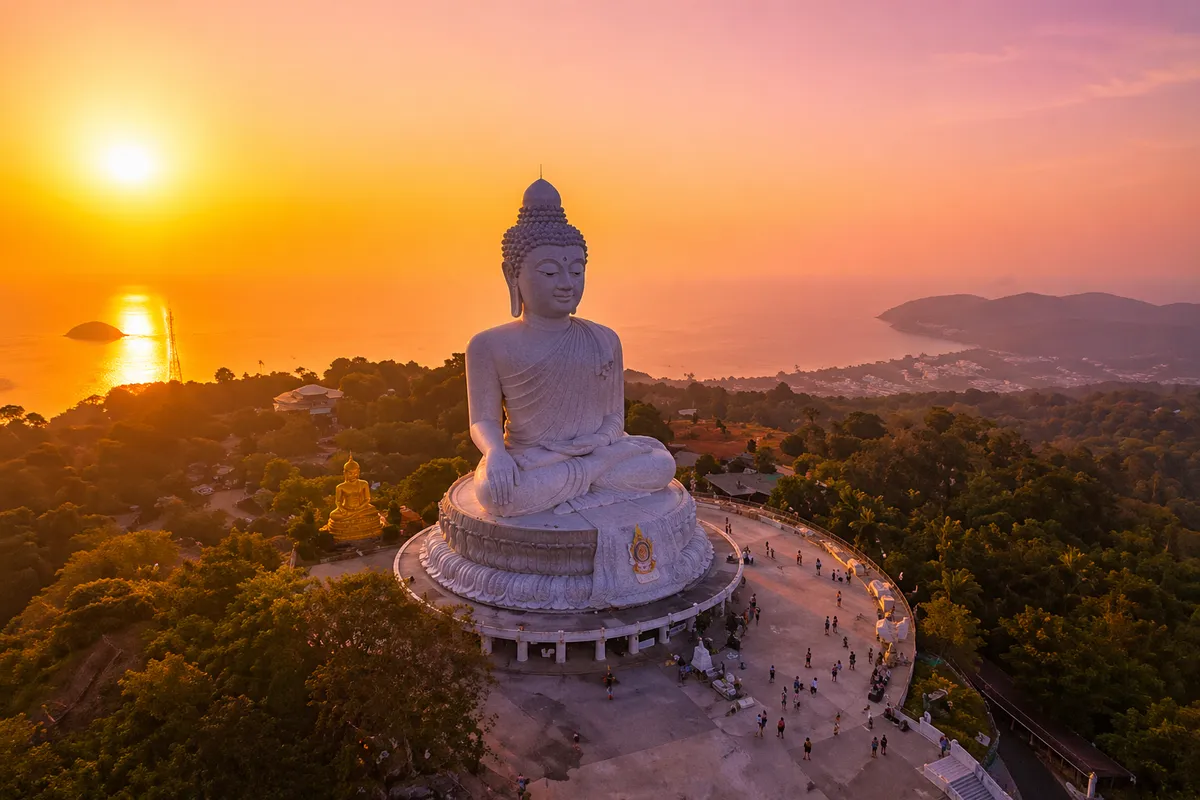
Temples and the big statue
The Big Buddha. A forty-five-metre white figure on Nakkerd Hill, visible from most of the southern half of the island. The reason to go is less the statue than the panorama: Chalong, Kata and Nai Harn are all in view from one platform. Entry is free and there is a dress code: covered shoulders and knees, with sarongs handed out at the gate. Go early morning or the hour before sunset; standing on white marble at midday is punishing.
Wat Chalong. Phuket's principal working temple, dedicated to two nineteenth-century healer monks. Unlike the Buddha this is not a viewpoint but a living place: people come to pray, burn incense and set off firecrackers in a dedicated furnace when a vow has been fulfilled. The tiered stupa with its relic and the wall paintings are the substantial part.
Wat Phra Thong, with a golden Buddha half sunk into the ground, and Wat Srisoonthorn with its reclining Buddha are second tier but both quiet and free of coach parties.
Viewpoints
Promthep Cape. The island's southern tip and its main sunset spot. Half an hour before sunset it is busy and the car park is full, so arrive early. Nearby stand a lighthouse with a small maritime museum and an elephant shrine.
Khao Rang. A hill above Phuket Town looking over the eastern side of the island, the port and the bay. Less touristed than Promthep, with a park and cafes. A good evening option if you are not staying on the west coast.
Karon Viewpoint, also called Three Beaches. One of Phuket's most recognisable shots: Kata Noi, Kata and Karon in a single frame from above. The platform is small and sits directly on the mountain road.
The Windmill Viewpoint beyond Nai Harn is the next stop along the same road, looking over Ya Nui bay and the open sea.
Phuket Town
The Old Town is the island's most underrated quarter and the only place really worth walking. Late nineteenth-century Sino-Portuguese architecture: two-storey facades with columns and shutters, left over from the tin mining era when Phuket was rich on something other than tourism.
The core is Thalang, Dibuk and Phang Nga streets plus Soi Romanee. Cafes in former merchant houses, street art, shops selling local ceramics. On Sundays Thalang becomes a walking market: the street closes and fills with food and music. It is the best of the island's night markets and has little in common with the usual tourist stalls.
Allow at least half a day and come towards evening, because the lanes are hot and empty in the middle of the day.
What else earns the trip
Bangla Road in Patong is not an attraction in the ordinary sense but a phenomenon worth an hour of your time to form your own view. It comes alive after nine in the evening.
Phuket Aquarium on Cape Panwa is small but holds a decent collection of local marine life and works well as a rainy day with children.
Cape Panwa and the eastern bays see almost no tour traffic, which is a shame: quiet villages, boat moorings and views across the islands of Chalong Bay.
Deliberately absent from this list: Samet Nangshe, Phang Nga Bay and Phi Phi, which are not on Phuket and belong to separate day trips. Also the zoos with monkey and tiger cub shows. The animal welfare questions there are real, and we set out the criteria in the piece on elephant parks.