Why this is a question at all
Ten years ago an elephant ride was part of almost every Thailand trip. Major operators have since dropped it, and the market responded predictably: the word sanctuary appeared on the signs of places that changed nothing but the sign. Phuket and neighbouring Phang Nga have dozens of such sites, and the gap between them is enormous.
The difficulty is that the difference is not obvious from the outside. Elephants look calm in both kinds of place: in an animal put through traditional training, calm is learned behaviour rather than wellbeing. So the thing to judge is not the general impression but the specifics of the programme.
We take guests to one park and do not swap it for another even when a neighbour quotes a lower wholesale price. Below are the criteria that park was chosen on. They are universal: use the list anywhere, including if you go on your own.
Red flags: one is enough
Riding. The simplest marker. An elephant spine is not built to carry weight on top, and the wooden howdah saddle weighs tens of kilograms before anyone sits in it, chafing the back over a long working day. No real sanctuary offers rides, neither short ones nor bareback on the neck.
Shows and tricks. An elephant that paints pictures, plays football, spins hoops or stands on its hind legs was not taught that kindly. Performing on cue is a direct product of the traditional training Thailand calls phajaan.
A bullhook in the handler's hand. A metal hook on a wooden handle is the working tool of the old system. In honest places the mahouts carry a basket of bananas and nothing else. If the hook is there but reportedly never used, it is still there, and the elephant knows it.
A short chain as the default state. Overnight tethering for safety exists even in good parks, but during the day an elephant should be moving around the property rather than standing in a circle the width of its own body.
Baby elephants with tourists and without their mother. Separating a calf from the herd is not something a sanctuary does by definition. If feeding a baby is sold separately from the herd, start asking questions.
The contested one: bathing with elephants
River bathing was long treated as the harmless alternative to riding, and it is still in most programmes because it photographs best and sells best. Over recent years the specialist position has shifted noticeably: when group after group is walked into the water with the same elephant all day, that is a repeated procedure staged for people rather than an animal bathing.
The reasonable middle ground, found in decent places: the elephant enters the water when it chooses, guests watch from the bank or stand nearby, and nobody sits on it or scrubs it on a timetable. The wording usually gives it away: bathing with elephants every half hour and the elephants bathe, you can watch are not the same offer.
If the water photo is exactly what you came for, it is more honest to say so and pick a place that at least meets the other criteria. There are not many good options on the island, and pretending otherwise helps nobody.
What an honest programme looks like
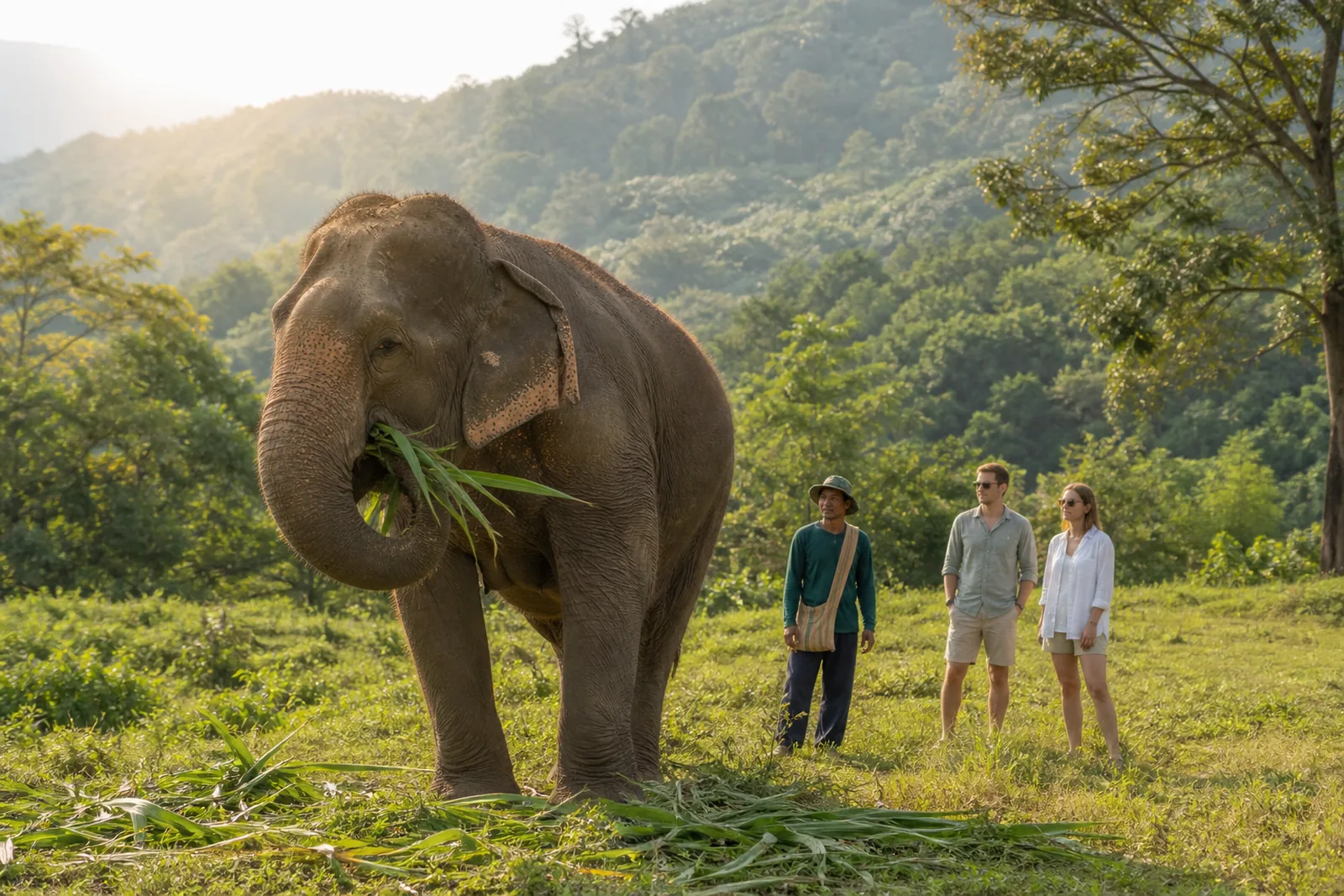
You arrive for the morning or afternoon feed and hear where each elephant came from: in a real sanctuary the animals have histories (logging work, begging on the streets of Patong, a tourist camp). That is the first sign you are not being told a marketing story.
Then hand feeding with bananas and sugar cane, walking with the herd across the property at a distance, watching a mud bath. The active part runs an hour to ninety minutes: elephants eat up to eighteen hours a day, and the programme fits around them rather than the reverse.
Group size stays under ten to fifteen people per herd. If coaches unload one after another and fifty guests share the area, calm contact is physically impossible.
The drive from Phuket takes forty minutes to an hour and a half depending on your hotel, since most honest parks sit inland or already in Phang Nga rather than in the tourist strip. That is itself a soft signal: land is cheaper there, and the herd has room to walk.
What to bring and what to expect
Clothes you do not mind ruining: parks are muddy, and that is the point. Closed shoes rather than flip-flops. A spare shirt if you plan to go near the water. Insect repellent, as these places border forest.
The programme does not depend on the sea or the weather: elephants are perfectly happy in rain, and park tracks are built for the wet season. That makes it a solid choice for a day when sea tours are cancelled because of swell.
And one honest expectation: the elephant will not come on command or do what you saw in someone else's video. That is why these places count as ethical: the animal behaves as it likes, and the programme is built around that.